African culture isn’t a museum exhibit. It’s a living, breathing thing, and the people doing the work to protect it are not waiting for permission.
Every February, conversations about Black history get louder. Schools invite guest speakers. Companies post graphics. And then March arrives, and the noise dies down. But for a growing community of artists, filmmakers, and cultural architects, the work of preserving African culture isn’t seasonal. It’s a daily practice, urgent and deeply personal.
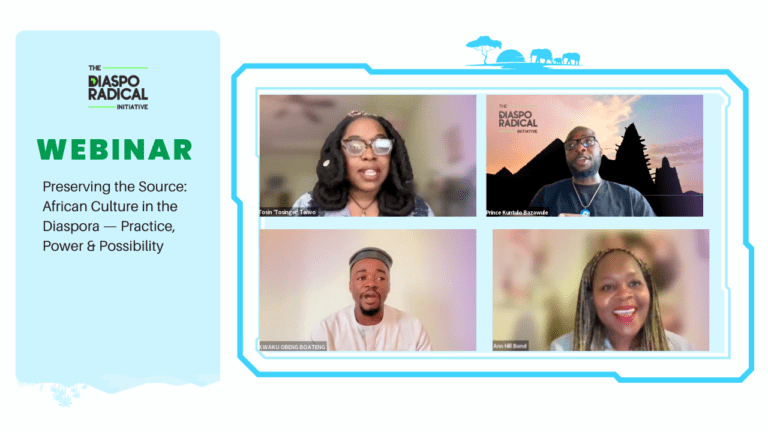
That thread ran through “Preserving the Source: African Culture in the Diaspora, Practice, Power and Possibility,” a webinar hosted by The Diasporadical Initiative on February 26, 2026 and moderated by Ann Hill Bond, US-based journalist and preservationist. Three panelists sat down to unpack what preservation actually looks like: Prince Kuntulo Bazawule, co-founder of The Diasporadical Initiative (TDI), based in Barbados; Kwaku Obeng Boateng, filmmaker and founding member of Africa Film Society, based in Accra, Ghana; and Tosin Taiwo, known as Tosinger, Nigerian singer, actress and storyteller, based in Atlanta.
Here’s what stayed with us.
One of the most striking ideas of the conversation came from Prince, who pushed back hard against the idea that culture is something you visit rather than something you live.
“We see culture, not just as a word, but as a living infrastructure,” he said. When culture gets treated like a museum piece, something behind glass, observed once a year, it dies quietly. But when it becomes infrastructure, it shows up in classrooms, in technology, in how communities are built and sustained.
This is the foundation of TDI’s work. Rather than presenting African culture as historical content, they weave it into programming across four pillars: culture, sustainability, technology, and entrepreneurship. Their flagship programme, Ancestral Intelligence (yes, they absolutely claimed the AI acronym), has schoolchildren in Barbados learning African history while physically building scale models of ancient structures from sustainable materials. The lesson isn’t just historical. It’s architectural, environmental, and deeply hands-on.
All three panelists circled back to the same conclusion: if you want to protect a culture, you start with children.
Tosinger put it plainly. Children are impressionable, and that’s exactly why they matter most. Through folktale storytelling at festivals, daily Yoruba proverbs on TikTok, and school visits during Black History Month, she takes stories that elders once told by moonlight and translates them into formats today’s kids actually consume.
What’s remarkable is how connected those ancient stories already are across the diaspora. The Ijapa tortoise from Yoruba folklore, Anansi the spider from Ghanaian tradition, and Brer Rabbit from African-American storytelling? Same character. Same archetype. Just filtered through generations and geography. Tosinger describes it like a game of telephone: the root stayed the same, but the details shifted. Knowing that connection exists is powerful for a young person in the United States, or the United Kingdom, or the Caribbean.
Kwaku’s work in Accra takes a similar approach through film. Africa Film Society runs Classics in the Park, a free outdoor screening series that introduces younger audiences to classic African cinema, not to recreate the past, but to build on it. There’s a Ghanaian concept for this: Sankofa. Learn from what came before to shape what comes next.
This is where the conversation got more intense. Cultural preservation isn’t just a cultural act alone. It’s a political and economic one.
African culture is constantly being borrowed, remixed, and monetised. The Ghana Must Go bag, the iconic checked holdall that every African auntie owns, now sells for thousands in luxury fashion markets. Mobile money, one of the most transformative financial technologies in the world, grew from traditional community systems, organic to African economic life for generations. Black Panther became a multi-billion dollar franchise built entirely on an African cultural foundation.
Who benefits? That’s the question our panelists kept returning to.
“We need to own our systems,” Prince said. “If it’s your IP, you own your IP.”
Kwaku offered a sobering example from his own experiences: trying to acquire classic African films to screen for free through Africa Film Society, only to find that the rights are held by people with no connection to the continent at all. The filmmaker told the story. Someone else owns it. It’s a reminder that cultural preservation and legal ownership are not separate conversations.
This is why ownership matters across every level: content, platforms, institutions. Tosinger tied it back to economic self-determination: “Until the lion tells his own story, the tale of the hunt will always glorify the hunter.”
One question from the audience asked what ties the diaspora together across geography. The answers came quickly: rhythm, language, food, fashion, storytelling, movement, music.
These aren’t just shared interests. They’re evidence of a root system that displacement couldn’t destroy. As Prince put it, the DNA doesn’t forget. The rhythms you think of as intrinsically Caribbean? African. The storytelling traditions woven into African-American culture? African. These threads run through everything, and recognising them is part of the preservation work too.
The panelists closed with concrete asks, not inspiration, but action.
Kwaku: Take ownership of your content. A smaller deal with more creative control is worth more, long-term, than a bigger one that strips your voice from the story.
Tosinger: If you’ve never visited Africa, make it a goal. Save. Plan. Go. Let the continent speak for itself.
Prince: Tap into your ancestral intelligence. You already carry what you need. The knowledge is in you, and the work is learning to trust it.
African culture is being filtered, borrowed, and sometimes flattened, but it’s also being fiercely, creatively, and deliberately protected by people who understand exactly what’s at stake.
Watch the full discussion here:

Deidre is the Marketing and Communications Lead for the Diasporadical Initiative. She is a Certified Digital Marketing Professional, foodie and avid traveller.